Tuesday, November 27, 2012

13) The Empty Interior

One of the most notable landmarks located in the Empty Interior is the Hoover Dam.  The Hoover Dam, located 25 miles southeast of Las Vegas, was completed in 1936 and controls the flow of Lake Mead while producing large amounts of hydroelectric power.  Most people don't know this, but Malibu has a dam of its own.  Rindge Dam, named after Malibu's founding family, is located in Malibu Canyon and controls the flow of Malibu Creek.  Rindge Dam was completed a full 10 years before the Hoover Dam in 1926.


While Rindge Dam may be older than the Hoover Dam, the Hoover Dam is considerably larger.  The Hoover Dam measures almost 730 feet high compared to Rindge Dam's 100 feet.  Rindge Dam is accessible only by foot after an intensive hike and is frequented by only the most dedicated hikers while Hoover Dam attracts about 1,000,000 tourists every year.  


One interesting fact about the Hoover Dam is that of the electricity it produces, 56% of it goes to power parts of Southern California.  Rindge Dam does not produce any power, however one interesting fact about it is that the frame is made out of the 15 miles of old rail of the railway that used to pass through Malibu.  Many environmentalists have protested for the deconstruction of Rindge Dam, but that would cost about $80 million and the effects of the increased flow of Malibu Creek are unknown.  


12) The Great Plains and Prairies

While not all of the Great Plains and Prairies are completely flat, the majority of it is.  This is not to say that all of the plains lay in low elevations.  The eastern end of the plains are about 1500 feet above sea level and slowly merge into the western end that lays about 6000 feet above sea level.  The change in elevation between eastern and western ends happens very gradually.

The flatness of the Great Plains are in stark contrast to the dramatic mountains located in Malibu.  The Santa Monica Mountain Range that runs through Malibu (along with many other coastal cities) allow for elevations ranging from 0 feet above sea level at the beach to about 2000 feet above sea level at the highest points in Malibu.  While more mountains aren't necessarily better, it sure does allow for more (and different) photo opportunities.


Monday, November 26, 2012

11) The Agricultural Core

When viewed from a bird's eye perspective, land parcels in the Agricultural Core are rectangular in shape.  The reason behind this was so that land could be more accurately accounted for.  The Land Ordinance of 1785 began this trend.  It was then that land was delimited and split into territories determined by east-west and north-south lines.  The parcels were then divided into townships.  Townships were originally 36 square miles.  From there, land was divided even more precisely before being put up for sale.  This led to what looks like a rather precise grid of land when viewed from above.

All of this is in stark contract to the orientation of Malibu.  Malibu is situated on a narrow sliver of land along the coast with no room for grids of land.  Homes and shops are built wherever they will fit.  Many homes built right into the sides of mountains.  When viewed from above, there is no order or organization of Malibu's properties.

Do these regions' people embody their land orientation ideals?  Are people in the Agricultural Core more conservative and old-fashioned because their properties are all organized into perfect squares?  Likewise, are residents of Malibu more free-thinking and independent because of the lack of structure in the organization of their properties?  It's unlikely that land organization is the sole cause of these character traits, but it is interesting to consider, no less.


10) The Southern Coastlands

Both Southern California and the Southern Coastlands share one large commonality.  Their beaches are widely known as the most beautiful beaches in the country.  The humid, subtropical climate in the Southern Coastlands is much different from that in Southern California.  The Southern Coastlands have mild winters and hot summers along with year-round humidity, while Southern California's coastlands have mild winters, warm summers, and relatively dry weather year-round.

So which region has the better coastlands?  Is it a matter of preference?  Do people from the East Coast automatically think Florida's beaches are better than California's?  Do people from the West Coast think that California has the better beaches?  The beaches themselves are different.  While the beaches in Florida may have bluer water and whiter sand, the beaches of California have a dramatic backdrop of mountain ranges.

So which do you prefer?  The coastlands of areas like Florida or the coastlands of California?


Sunday, October 14, 2012

9) The Changing South

Chapter 9 discusses the changes that the South has undergone over the years.  From racial tension to economic drama, the South has changed over the years, yet remains distinctively as "The South."

Malibu, in its most current form since the late 1920's, has not changed all that much.  Its most significant change came in the 1920's when the Rindge family who owned all of the property in what is now Malibu fought a fierce court battle to keep the Pacific Coast Highway out of their land.  Eventually, they lost the court battle, and the highways was built.  Upon completion in 1929, Pacific Coast Highway separated the Rindge land from the shoreline, signaling an end to the last private Spanish land grant.  Due to the length and scale of the court battle, May Rindge was forced to begin leasing and selling parcels of the family's land to pay legal fees.  She created the Marblehead Land Company and sold pieces of land to outsiders, opening up the property to those looking for an escape from the bustling Los Angeles.  It was common for Hollywood movie stars to buy this land and eventually a small neighborhood was created that was called, "Malibu Movie Colony."  This small subsection of Malibu is now known today as the exclusive Malibu Colony.  Since then, Malibu has continued to grow into the public, yet exclusive city it is today.


8) Malibu and Long Beach

Chapter 8 compares two different cultures at different ends of the Appalachian mountains.  To mirror this and make a new comparison, we can compare Malibu and Long Beach.  Both are cities located on the coast and enjoy the Pacific Ocean.  The two citties are only about 50 miles away from each other, yet they are very different.

Both Malibu and Long Beach enjoy nearly the exact same Mediterranean climate with warm temperatures throughout the year and relatively little rainfall.  One difference between the two is that Malibu has much more complex terrain, while Long Beach is relatively flat, allowing for larger, more commercial structures.

The two cities differ greatly in their demographics.  While Malibu is about 90% white, Long Beach is much more diverse.  Long Beach's population is 46% white, 40% Hispanic, and about 14% African American.  Another area where the two cities differ greatly is in median income.  While the median income in Malibu is well over $100,000 a year, the median income in Long Beach is just under $40,000 per year.  This makes a large difference in the make up of retail outlets, housing, and restaurants.  While Malibu has exclusive, high end retail outlets and restaurants and large, unique homes, Long Beach has more generic, lower-price retail outlets, chain restaurants, and smaller homes.
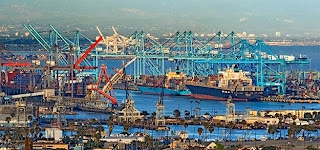
Long Beach does benefit from great accessibility and large industries.  The Port of Long Beach is a large shipping port that is the entrance to America for many foreign goods.  Also worth mentioning is Long Beach Airport, which provides another option for those traveling in California, but not wanting to deal with the crammed LAX.  Long Beach also has several large-scale employers, such as the Long Beach Unified School District, Boeing, and California State University Long Beach.  Part of this is due to the fact that larger cities have larger companies, so a small city like Malibu would never attract a company like Boeing.  These large employers offer many jobs to its citizens.
Another interesting point of difference between the two cities are in their festivals.  Malibu's paramount festival is the Malibu Chili Cook-Off, a weekend-long small street fair and carnival.  In Long Beach, the paramount event is the Long Beach Grand Prix, a weekend where several streets are closed, and racecars including Indycars and Le Mans racers contest a race around the streets of the city.  Having been to the race numerous times myself, I can say that Long Beach makes for a great setting for an event that is known as a great street party, and there is even a race happening in the background.  The Long Beach Grand Prix is well known worldwide, and over 200,000 people attend it every year.

7) The Opposite of the Bypassed East

Chapter 7 discusses the region of northeast North America called The Bypassed East.  This region is described as being a relatively cold and bleak place.  Malibu is almost the polar opposite of the Bypassed East.

While the Bypassed East is cold and receives substantial precipitation, Malibu is generally warm throughout the year and receives very little precipitation.  While both the Bypassed East and Malibu are very mountainous, they are quite different in nature.  The mountains of the east only contain civilization in their lowlands and valleys, whereas in Malibu, residences and business are built right into the hillside.

In the Bypassed East, farming was never easy, and has only been in decline.  In Malibu, farming was never significant, but there are several small wineries scattered across hillsides that offer locally made wine.


While commercial fishing is a large industry in the Bypassed East, in Malibu, this is not the case.  There is some private fishing, but not nearly on the same scale as in the east.  One theme remains the same between the two regions.  Pollution is endangering the fishing industry in the East.  While there is no business industries in danger due to pollution, it is still a big concern in Malibu due to the wildlife being put at risk.


In the Bypassed East, half the population lives in small cities, while the offer half lives in rural areas.  There is no real "city" type of densely populated area in Malibu, so just about all of Malibu is considered rural.  There are, however, areas that are more rural than others.  While some homes are built in small development communities, there are others that are standalone homes built into the hillside.  These homes are set back into the hills and are very unique.
The demographic and economic patterns of the Bypassed East are undergoing transformation and the future is uncertain.  In Malibu, it is quite the opposite.  The demographics remain the same as they have for several decades.  Malibu is a home to a predominantly white population, and largely households without children.  It is a city made for upper class, wealthy people who enjoy their freedom.